

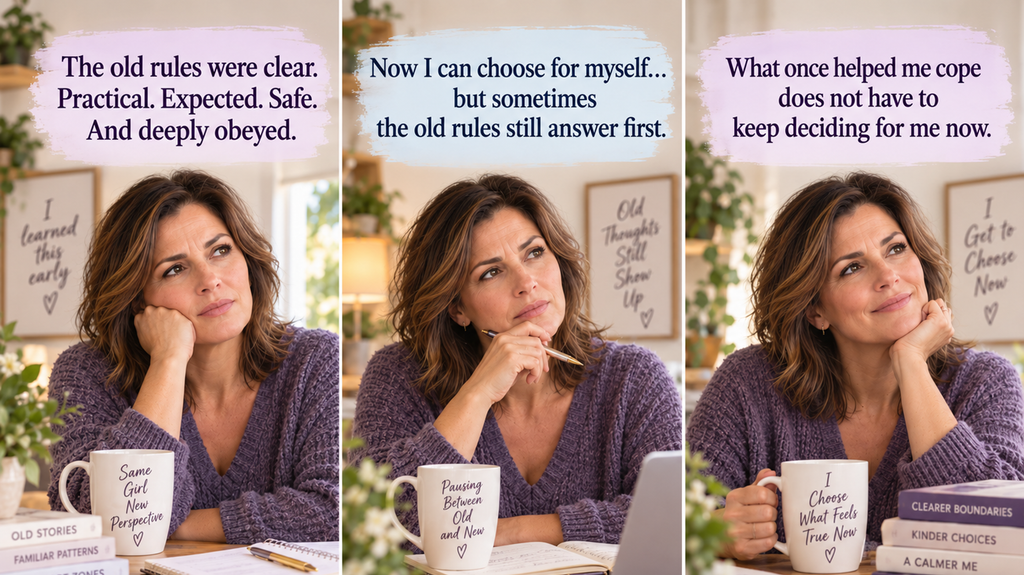
Have you ever felt a clear desire rise in you, only to have an older voice immediately explain why it wasn’t practical, possible, or allowed?
Daisy remembers the rules of her childhood home.
- Some were spoken often.
- Some were enforced firmly.
- Some were wrapped in practicality, safety, money, manners, or common sense.
“Don’t sit too close to the television.” – Her mother firmly believed it would ruin your eyesight.
“Clean your plate. There are starving children in [country].” – Food was not to be wasted. Food represented hard-earned money and survival.
“Don’t go outside with wet hair. You’ll catch your death of cold.” – The belief was clear: defying the elements meant risking your health.
“Be home when the streetlights come on.” – It was not practical or safe for children to be out after dark.
Most of the children Daisy knew grew up with rules of do and don’t.
But in Daisy’s home, rules went further than safety.
You were not really invited to have thoughts, needs, opinions, or desires that challenged the household order. You did not have to guess what was allowed. There was no room for discussion because: “Because I said so.” took away any doubt of what was considered right or wrong.
And that was that.
Now Daisy is an adult.
- She can make her own choices.
- She can voice her own wants and needs.
- She can decide what fits her life now.
- … Except she seldom does.
When someone asks her, “What would you love?” or when her friend Terry asks, “What would feel more true, steady, and life-giving now?” Daisy often has a hard time saying anything out loud.
Not because she does not know that something inside her wants more.
But because wanting more still feels wrong.
Sometimes it even feels wrong to admit it quietly to herself.
Daisy is grateful for Terry because Terry is one of the few people she can share a little of this with. Not the full picture yet, perhaps, but enough to give the truth some air.
She shares abstract glimpses of what she longs for.
- More space.
- More clarity.
- More expression.
- More support.
- More alignment.
A life that feels more honest from the inside.
But before Daisy can fully honour those desires, an old rule often answers first.
- I don’t have time.
- I’m not ready enough.
- I don’t have enough energy.
- It’s selfish to want more.
- If I ask for more, I may lose what I already have.
- If I become more myself, someone may be disappointed.
The old rules are not random.
They had a purpose.
They helped Daisy stay accepted, included, responsible, safe, and easier to approve of at home, at school, in public, … and in the society her mother and grandmother had known.
But as Terry gently asks her:
“At what cost?”
“What is the real-life cost of obeying old rules that no longer fit the life you are building now?”
Daisy begins to see that her old inner rules may be costing her:
– her voice
– her energy
– her self-trust
– her momentum
– her peace
– her ability to choose what fits now
Terry reminds her that the steadier next step does not need to be dramatic.
Daisy does not have to rebel against everything from her past.
- She does not have to force a huge leap.
- She does not have to shame the part of her that learned those rules.
- She can begin by noticing when an old rule rises up.
Then she can name it and ask:
“Why does this feel impractical, impossible, or not allowed?”
And then:
“Does this rule still belong to the life I am building now?”
From there, the next step can be small.
- One honest thought.
- One clearer boundary.
- One desire admitted quietly.
- One choice that honours what feels true now instead of what once kept everyone else comfortable.
As Daisy gives herself permission to fully think her own thoughts, something begins to shift.
She realizes she doesn’t have to keep living by rules created for a version of herself who was only trying to survive. She now was ready to thrive.
Those rules had their place.
But they do not need to decide everything now.
Her steadier self can begin choosing differently.
And now, dear reader, I ask you:
“What Would You Choose If Your Old Rule Wasn’t Deciding?”